


Dead Space, Real Income: Earning from Unused Property in the Philippines | Leeveit
June 26, 2026
Leeveit Is Opening Its First Storage Lockers in Poblacion, Makati — Here’s What to Expect
September 4, 2026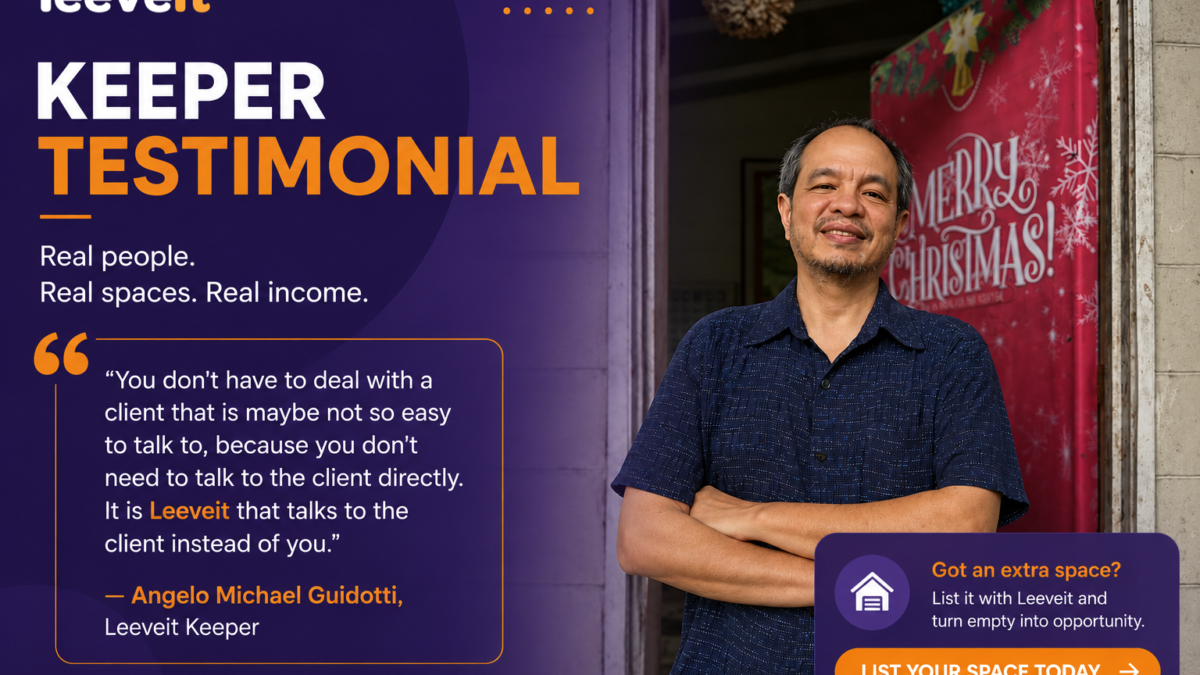
A Parking Slot Sitting Idle Since the Pandemic
March 2020. Metro Manila didn’t just slow down, it stopped. Overnight, businesses shuttered. Roads that usually choked with commuters fell empty. And for Filipino families who had built their lives around the rhythm of a working city, the financial ground gave way beneath them without warning.
Angelo Michael Guidotti felt that shift like most businessmen did: immediately, and without a clear end in sight.
To save on gas during the lockdown, he was sleeping at the office. Back home, two to three parking slots sat completely unused. No cars coming in. No income coming in. Just space, quiet, still, and generating nothing during one of the most financially brutal periods many Filipino families had faced in their lifetime.
What made it worse wasn’t the emptiness. It was the slow realization that idle doesn’t mean free. An underutilized parking space in Metro Manila isn’t just inconvenient. It’s a missed opportunity compounding quietly every month you leave it alone.
The turning point didn’t come from Michael. It came from his wife.
Scrolling through options one evening, she found Leeveit. A platform that connects people who have unused space with people who need it. The concept was simple enough: list the slot, reach renters who were already searching, and start earning from something that was doing nothing. No industry background. No complicated paperwork to start.
For a family managing uncertainty on every front, that simplicity wasn’t a luxury. It was the only version of the idea they had bandwidth to try. And they weren’t alone. The pandemic fundamentally reshaped how Filipino families think about income and opportunity, pushing many to look at what they already owned in a completely different way.
What they didn’t know yet was how little stood between them and their first renter.
The Honest Doubt: Can You Really Trust an Online Platform With Your Property?
Here’s something most platforms won’t say directly: giving a stranger access to your property, even just a parking slot, doesn’t feel comfortable. It doesn’t matter how small the space is. It’s yours. And handing it over through a website you found two weeks ago takes a kind of trust that doesn’t come automatically.
In 2020, that hesitation had even more weight behind it. Online scams were everywhere. Digital platforms were still earning credibility with a generation of Filipinos who had built their lives around face-to-face transactions. The doubt Michael and his wife felt wasn’t a red flag. It was a reasonable response to a genuinely unfamiliar situation.
Is this platform legitimate? What happens if something goes wrong? Who exactly will be showing up to use my space?
These are the questions almost every property owner carries into their first listing and almost nobody in the industry addresses them honestly. Most platforms bury the doubt under income projections and success stories. The hesitation gets treated as a problem to be eliminated rather than a feeling worth acknowledging.
Michael didn’t pretend it wasn’t there.
“Like everything else, in the beginning, there are always doubts. But as time goes by, as you talk to the people involved in that venture, you get to know the person, you earn trust.”
— Angelo Michael Guidotti, Leeveit Keeper
That’s not spin. That’s how trust actually works — built in layers, through conversations, through small moments where the platform does what it said it would. For Michael, the doubt didn’t lift all at once. It faded gradually. A call with his Leeveit account manager. A clearer picture of the process. And eventually, the experience of watching it work exactly as described.
There’s a practical lesson in how he approached it. He didn’t hand over his entire property. He listed a parking slot. The risk was small. The upside was real. And the fastest way to find out if it was worth it was to try. It’s worth noting that demand for parking in Metro Manila far exceeds available supply — which means the renters were already out there. Michael just needed to make his slot findable.
For property owners sitting on the same doubt today, his path forward is the same: ask every question you have, get comfortable with how the process works — and then take one step small enough to feel manageable. Certainty doesn’t come before the first move. It comes from it.
And the first move, it turned out, was far simpler than the doubt had made it seem.
What Signing Up on Leeveit Actually Looks Like
Most people assume listing a property online follows the same arc as any other Philippine real estate transaction: paperwork, legal review, back-and-forth negotiations, and a waiting period that stretches longer than anyone admits upfront. It’s a fair assumption. Because for most property dealings here, that’s exactly what happens.
Leeveit is a different kind of process.
When Michael’s family decided to try it, they were working against two disadvantages: they were doing something they’d never done before, and they weren’t particularly tech-savvy. Their kids ended up helping with parts of the setup. And yet the listing went live. That detail matters — not as a feature claim, but as proof that the platform was designed for real people, not just digitally fluent early adopters.
The mechanics are straightforward. You enter your space details: location, dimensions, access conditions, availability and your listing goes live on the platform. It works conceptually like any property site you’ve used before, except it’s built specifically around parking, storage, and flexible commercial spaces rather than homes and condos. No specialized knowledge. No real estate credentials required.
What happens next is where Leeveit separates itself.
Instead of leaving new Keepers to navigate the system alone, the platform assigns a dedicated a real person who coordinates on the ground, answers questions, and manages the inbound process as interest comes in. For a first-time lister, that human layer is the difference between feeling lost inside an unfamiliar system and feeling guided through it.
“You just put the space into the website. Talk to the contact person in Leeveit that is in charge with your account. And then eventually, if a client sees it online, Leeveit will communicate with you. Once it’s agreed, it’s okay.”
— Angelo Michael Guidotti, Leeveit Keeper
No direct negotiation with strangers. No wondering what happens after you hit submit. When a potential renter shows interest, Leeveit contacts to the renter, not the other way around. The owner doesn’t have to chase anything or manage any uncertainty about next steps.
For a family navigating a pandemic, a new platform, and an unfamiliar process all at once, that structure wasn’t a convenience. It was the reason they followed through instead of quietly abandoning the idea after the first confusing screen.
And what waited on the other side of that first step was something Michael hadn’t fully prepared himself for, the part of the process he’d been most nervous about turned out not to be his problem at all.
The Part Michael Didn’t Expect: No Renter Headaches
If you asked a room of Filipino property owners why they haven’t listed their unused space, most wouldn’t say they don’t need the income. They’d say they don’t want the trouble.
And the trouble they’re imagining is specific. It’s the renter who stops paying after month two. The one who leaves the space worse than they found it. The one who messages at 10pm about something that could have waited until morning. Managing renters anywhere carries a reputation for being exhausting — and in the Philippines, where most landlord-tenant relationships are handled directly and personally, that reputation is not entirely without basis.
Michael felt that weight even before his first renter showed up.
He was glad the slot was finally being used. But underneath that was a quieter unease uncertainty about who would be pulling in, whether they’d respect the space, and what kind of ongoing relationship he was signing up for with someone he’d never met. It’s a feeling most first-time Keepers carry without saying out loud.
What resolved it wasn’t a reassuring conversation. It was the structure of the platform itself.
“You don’t have to deal with a client that is maybe not so easy to talk to, because you don’t need to talk to the client directly. It is Leeveit that talks to the client instead of you.”
— Angelo Michael Guidotti, Leeveit Keeper
This is the aspect of Leeveit that tends to catch new Keepers most off guard. The platform doesn’t broker the introduction and then disappear. It stays in the middle. Communication, payment follow-ups, concerns, disputes all of it runs through Leeveit. The Keeper’s ongoing relationship is with the platform, not with individual renters. The awkward conversations, the chasing, the ambiguity, the parts that make most people hesitate largely never arrive.
Michael’s anxiety didn’t fully dissolve until he met his renter in person and saw that everything was fine. But that moment of relief was made possible by a system that had already handled everything leading up to it. By the time the two of them were face to face, there was nothing left to navigate.
That’s what passive income from a parking slot in the Philippines actually looks like when the platform is built to protect both sides. Not just income with less effort but income with almost none of the interpersonal friction that stops most property owners from listing in the first place.
Which raises the obvious follow-up: if Leeveit handles the renters, what exactly is left for the Keeper to do?
What Leeveit Handles So You Don’t Have To
The honest answer: not much.
As a Keeper, Michael doesn’t advertise his space. He doesn’t field inquiries, vet applicants, or negotiate terms. He doesn’t chase payments or mediate when something comes up. What he does is keep the slot accessible, stay responsive to his account manager, and receive income from a space that would otherwise sit empty.
Everything else such as finding renters, managing communication, processing payments, handling the relationship end to end belongs to the platform.
This distinction matters more than it might seem, because it’s what separates Leeveit from posting your space on a classifieds site and hoping for the best. On a classifieds site, the listing is just the opening act. You become the landlord, the customer service rep, and the collections team all at once. On Leeveit, the platform absorbs that load. The Keeper provides the space. The platform does the work.
For Michael, who already runs a family business, that division is not a small thing. A parking slot that demanded active weekly management wouldn’t be passive income, it would be a second job with unpredictable hours. What Leeveit delivers instead is income that fits around his life rather than interrupting it.
The financial return is modest and Michael says so plainly. What he earns from the parking space isn’t a life-changing figure. But it shows up every month, reliably, covering his family’s electricity bill which is a recurring expense consistently offset by a slot that used to cost nothing to maintain and return exactly that in kind.
That consistency, quiet as it is, tells the more important story. For a family that started listing out of pandemic-era necessity, the need that pushed them to try eventually passed. The income didn’t. Six years later, the slot is still listed. The bill is still covered. What began as a stopgap became a permanent fixture not because they kept optimizing, but because the platform kept working.
And the person who built that outcome is the same person who, not long ago, wasn’t sure the idea was worth trying at all.
From Skeptic to Keeper: What Michael Would Tell Other Property Owners
Six years is a long time to stay with something that started as a crisis-driven experiment.
Michael didn’t keep listing because he ran out of alternatives. He kept going because it worked steadily, without drama, and without demanding more from him than he was willing to give. That kind of durability is harder to manufacture than a good first impression. It means the platform didn’t just deliver when the stakes were high. It kept delivering when life went back to normal and he had other things to focus on.
When he talks to property owners who are still sitting on the fence, he doesn’t open with income figures. He opens with something harder to argue against.
“Don’t let opportunities like this go to waste. Especially if it’s just there and you’re not really using it — it’s a waste of the extra income that you can earn. At the same time, you’re teaching your children to go for opportunities like this.”
— Angelo Michael Guidotti, Leeveit Keeper
That last part is worth sitting with. For Michael, this was never only about the money. Listing a parking slot was a demonstration to himself, and to his kids of what it looks like to treat an idle asset as a real one. To ask not just what do I have, but what should this be doing. That shift in how he looks at the things he owns is something he considers worth passing on as much as the income itself.
There’s a practical logic underneath it. Real estate passive income in the Philippines doesn’t require a portfolio of properties or a background in asset management. Sometimes it starts with a single parking bay and the decision to stop treating unused as inevitable.
His advice to anyone still carrying doubt follows the same road he walked. Don’t wait to feel ready. Talk to the Leeveit team, ask your questions, understand how it works well enough to take one step and then take it. The doubt, in his experience, doesn’t disappear before you begin. It disappears because you did.
“Keep fighting. Never give up. Never lose hope. Look around. See the opportunities — make an empty space that’s not being used earn for you a little bit.”
— Angelo Michael Guidotti, Leeveit Keeper
It sounds simple. It is from a man who started in the middle of a pandemic, with no experience listing property online, no certainty it would work, and no backup plan if it didn’t.
He’s still here. The slot is still listed. The income is still coming in.
The only thing he says he’d change, looking back, is the timing. He wishes he’d started sooner.
Your Space Could Be Doing More
Strip away everything else and Michael’s story is this: a parking slot that sat empty for months is now paying his family’s electricity bill every month. No complicated investment. No industry knowledge. No prior experience renting out property. Just a space he already owned, a platform that handled what he couldn’t, and the decision not to keep waiting.
That story isn’t unique to him. It’s repeatable and there are more property owners in Metro Manila sitting on the same opportunity right now than most would guess.
If you have a parking slot going unused, a storage room that hasn’t been touched in months, or a commercial space in a holding pattern waiting for the right long-term tenant who hasn’t materialized the gap between where you are and where Michael is isn’t talent or timing. It’s a listing.
The demand for flexible, accessible space in Metro Manila is real and it isn’t going away. Online sellers need storage. Professionals need parking near where they work. Small businesses need space without committing to years-long leases. The renters exist. What’s missing, in most cases, is the supply side making itself available.
Getting from idle to earning doesn’t require a renovation, a broker, or a legal team on retainer. It takes one conversation with the Leeveit team, a listing with your space details, and an account manager who takes it from there. That’s the entire distance between a slot that earns nothing and one that quietly covers a bill every month without asking anything more from you.
No property management experience. No technical know-how. No long contracts before you’ve seen a single peso.
What it takes is the same thing Michael brought to it in 2020 — not confidence, just the willingness to find out. If you want to understand what parking in Metro Manila actually looks like for renters who are already searching, this guide breaks down how the market works from the renter’s side — and it makes clear just how much unmet demand is already out there.
Six years later, Michael hasn’t looked back. He just wishes he hadn’t waited so long to look forward.