


Your Warehouse Is Not Full — Here’s What to Do With the Rest
October 10, 2026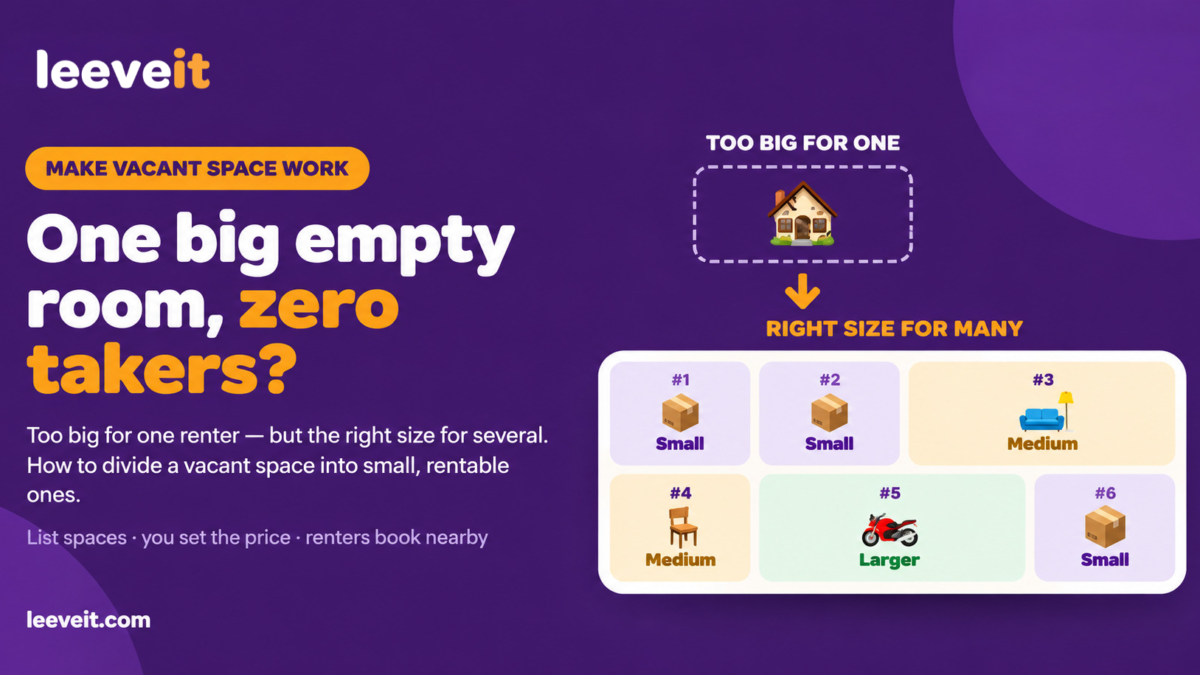
One Big Empty Room, Zero Takers
The ground-floor unit has been empty for eight months. The sign on the shutter has faded, and a few prospective tenants have come and gone. Each of them said roughly the same thing: too big, too much rent, too much commitment.
Now picture a young online seller a few streets away. She does not need a shop. She needs a corner for her boxes, close to home, that she can rent by the month.
Two people in the same neighborhood, and they never meet, because one is offering a whole floor and the other needs a few square meters. Metro Manila has plenty of residents, sellers and small businesses in that second group.
If you own a vacant commercial unit, an oversized garage or a ground-floor area you rarely use, this guide looks at whether dividing it into smaller rentable spaces could work for you, and how to go about it. Whether you hope to rent out garage space in smaller pieces or fill a former shop with several small units, the first step is the same: check that your property can be divided at all.
The Problem: A Big Space That Fits Nobody
Large spaces are hard to rent for a simple reason: the number of people who need all of it is small. A full commercial unit needs a tenant with a business plan, a fit-out budget and a long lease in mind. A double garage needs someone with several vehicles or a very large load of goods. Most people looking for space are not in that group.
If you are the owner, you know how this goes. You spend weekends showing the space to people whose needs do not match it. A prospect negotiates for two weeks, then disappears. You adjust the price, then adjust it again. The unit is ready to occupy, yet it earns nothing, and you hesitate to spend on improvements because you do not know who, if anyone, you would be improving it for.
Meanwhile the costs keep coming: association dues, utilities, taxes and upkeep. An idle area also tends to collect clutter, which makes it look even less appealing to the next person who walks in.
Waiting for the right tenant feels safe, but it is really a bet that someone with exactly the right needs will appear soon. Lowering the rent or waiting longer keeps you dependent on that one decision by one person. Subdividing is one way to change the question. Instead of asking who needs all of this space, you ask who needs part of it. It will not suit every property, but for the right one it can turn a long wait into several smaller opportunities. For a broader look at what counts as rentable, see our guide to renting out unused rooms and garages.
Why It Happens: Demand Is Small, Close and Monthly
Demand in Metro Manila has moved toward the small and the flexible. Condo units keep getting more compact, so residents run out of closet space quickly. Online selling has turned bedrooms and living rooms into stockrooms. Small businesses want to test a market before they sign for a full storefront. Many people also prefer to pay month to month so they can stop when their situation changes.
Here is the part that is easy to miss: your property may not be hard to rent because it is unattractive. It may be hard to rent because it offers more space than most renters need.
Most of these renters are not looking for a warehouse on the edge of the metro. They want something near their home, their shop or their route, in a size that matches what they actually own. That is why a divided garage or ground-floor area can make sense in a dense neighborhood: it sits close to where the demand is.
When the only option is the entire floor, the renter who needs three square meters is priced out of the conversation. When you offer small, medium and larger spaces, you give each person a size that fits. Location, price, access and security still decide whether they choose yours.
Your property may not be hard to rent because it is unattractive. It may be hard to rent because it offers more space than most renters need.
Before You Divide: What Owners Worry About
Most owners hesitate for a few of the same reasons, and each deserves a straight answer.
Can my space even be divided? Not always. Structure, layout, ventilation, access, security and fire safety all limit what is possible, and some properties are simply not suitable. Walk the space and ask whether each section would have its own safe access and a clear way out.
Is it allowed? That depends on your property. Check your lease or title restrictions, your homeowners’ association or condominium rules, and any requirements from your barangay or city hall. Fire safety and building rules matter too, particularly for walkways and exits. Ask before you build, not after. Our overview of legal and insurance considerations when renting out a garage is a good starting point, and it is worth confirming details with the right office or a professional for your specific property.
What if something goes wrong? Every rental carries some risk, and a good setup reduces it. Written house rules, a clear list of items that cannot be stored, controlled access and a simple agreement go a long way. We cover the common concerns in what are the risks of renting out my storage space.
Will I end up managing five renters instead of one? Possibly, and that is a real cost in time. More renters means more messages, more move-ins and more small decisions. Plan for it by keeping your house rules and a standard reply to inquiries ready, and by choosing a number of spaces you can manage comfortably. Leeveit is a marketplace, not a contractor or a broker. You prepare the spaces and set your own prices and terms. Leeveit gives renters a place to discover and book your listing, and its support team can answer questions about how the platform works. That can lighten the work of finding renters, but it does not replace running your space well.
Is it worth the effort? Smaller spaces can reach more kinds of renters, but results depend on location, price, access, security and the type of space. Treat subdividing as a test, not a promise.
The Process: How to Divide a Large Space into Rentable Ones
If your space passes the checks above, here is a practical way to go from one big room to several small ones.
Step one: confirm what is allowed and safe. Settle the lease, association and local requirements first. Depending on the space and the rules, dividing it might mean marked zones on the floor, light partitions, lockable doors or caged sections. Marking zones alone does not automatically create separate, rentable areas, so confirm what your property needs before you spend.
Step two: measure and map. Sketch the floor plan with real measurements. Mark doors, pillars, windows, outlets and any wet or damp areas. Leave a clear central aisle so every space can be reached without moving someone else’s belongings.
Step three: decide on a size mix. Plan a few different sizes rather than identical cells. Small spaces suit boxes, seasonal items and small sellers. Medium ones suit furniture, appliances and larger inventory. One larger space can serve a small business that needs more room. If you are unsure how much room common items take, our storage size guide gives a useful reference.
Step four: make each space secure and set house rules. Give every renter a lockable area or a clearly marked zone with controlled access, and number each space. Write down what can and cannot be stored, access hours, how notice is given and what happens if payments are late. Keep it short enough that renters actually read it.
Step five: list and price it. Take clear photos of each space with its size noted, describe the location and access honestly, and set monthly rates based on size and convenience. A first-timer’s guide to listing a space walks through the listing basics.
Step six: start small and adjust. You do not need to fill every space on day one. Open with a few, note how long each size takes to rent and which questions keep coming up, and adjust the layout as you learn. After a month or two, those notes will tell you more than any guess.
The Unexpected Benefit: Resilience, Not Just Rent
Subdividing does more than add listings. It changes how a vacancy affects you. When one tenant occupies your whole unit and leaves, income from that unit stops. With several renters, one departure takes away only part of it, and you can relist that portion on its own. Smaller spaces may also appeal to a wider range of renters, though how quickly they fill still depends on price, location, access and security.
The layout can adapt over time. If sellers start asking for more room before the busy season, you can combine two spaces. If a renter needs less, you can split one. A single large lease does not give you that flexibility.
A tidy, numbered, well-lit area also tends to attract renters who look after it, while an empty, dusty room tends to do the opposite. And a property that is in use stops being something you have to keep worrying about.
What Changes When You Manage Several Renters Instead of One
A single large tenant means one relationship, one payment and one set of expectations. When something goes wrong, it goes wrong in one place. Several renters mean smaller, more frequent interactions: more messages, staggered move-ins and move-outs, and different needs from each person.
Owners who handle this well tend to do three things. They set routines, such as fixed times to check messages and visit the space, so it does not take over the week. They keep a simple record of each space: number, renter, start date, monthly rate and payment date. And they apply the same rules, notice period and access hours to every space, so nobody has to ask what applies to them.
They also start with two or three spaces before dividing the whole area. If one size sits empty for weeks, they rethink the price or the size before building more of it. That keeps a bad guess cheap.
Take the First Step: Start with One Question
A large empty space is not necessarily a dead end. It may be a layout problem, and layout problems often have workable solutions. Start by checking whether your space can be divided safely and within the rules. Then plan a mix of sizes, make each area secure and write clear house rules.
Once your spaces are ready, you can list them on Leeveit. Add each space with its size, photos and monthly rate, and renters across Metro Manila can find and book it. Preparing the space is up to you. Getting it in front of renters is where the platform helps.