


Leeveit Is Opening Its First Storage Lockers in Poblacion, Makati — Here’s What to Expect
September 4, 2026
Subdivide to Earn: Turning a Vacant Ground-Floor Unit or Big Garage into Several Rentable Spaces
November 2, 2026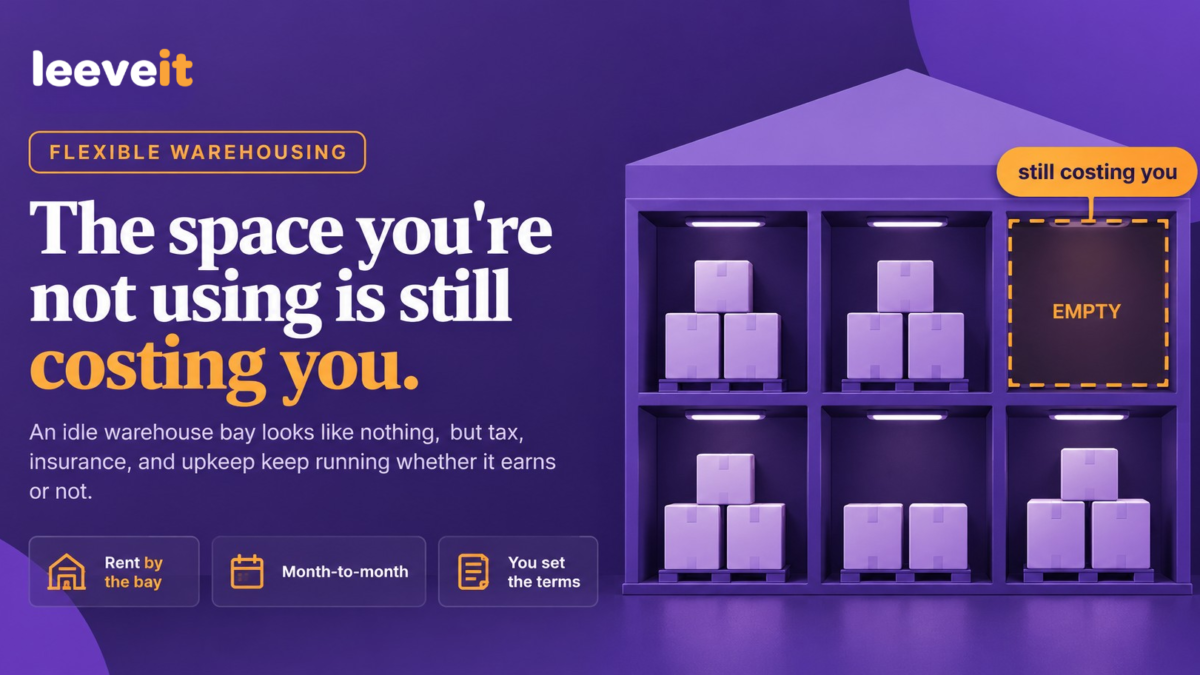
The Space You’re Not Using Is Still Costing You
Walk through almost any warehouse in the Philippines and you’ll find the same quiet detail: a back corner that hasn’t held inventory in months, a bay held for a tenant who moved out last quarter, a mezzanine nobody’s gotten around to filling. None of it looks like a problem. It just looks like space.
Market-wide numbers can make the industry look healthy, but averages flatten out what happens building by building. Between one tenant leaving and the next one signing, there’s almost always a gap. A slow quarter here, an early move-out there. Unused warehouse space doesn’t announce itself the way a vacant storefront does. It just sits there, unbilled.
And unbilled isn’t the same as free. Every idle square meter is still costing you, in the tax, insurance, and maintenance you’re paying to keep it standing. You won’t see this on a monthly P&L. It’s the kind of cost that only shows up once you add up a full year and notice the gap.
Most owners don’t treat that gap as a decision. It’s just what happens between tenants, a cost of doing business nobody questions. It’s an easy assumption to carry, and one worth a second look.
The Old Mental Model: Warehouse as Fixed Asset
It’s not that owners haven’t thought it through, the industry only ever handed them one model to think with. A warehouse gets built for one kind of tenant: someone who signs a long lease, fills the whole space, and stays for years. Full building or empty bay. Occupied or not. There’s rarely a category in between.
That model made sense when warehousing mostly served large manufacturers and distributors with steady, high-volume needs, and dedicated warehousing, where one company reserves the space exclusively, is still how much of the industry works.
The trouble is that this framework only knows how to answer “occupied or vacant.” It has no answer for “70% full.” When a warehouse loses a tenant, or never quite grows into its full footprint, the fixed-asset mindset doesn’t offer a next move. It waits for the next big lease to fill the gap, and meanwhile the space sits there, vacant and earning nothing.
That gap isn’t a failure on the owner’s part. It’s one the traditional model was never built to close, and the market is already starting to close it on its own.
Why Flexible Warehousing Is Catching On
Look at where the industrial market has actually been moving. Colliers reported that overall vacancy across Central Luzon, Metro Manila, and Southern Luzon fell to 13.1% in the first half of 2026, down from 16.8% a year earlier, with new supply absorbed by traditional businesses and e-commerce-related occupiers alike. Space is being taken up, and e-commerce occupiers are among those taking it.
A warehouse isn’t only operational infrastructure that’s either running or idle. It’s real estate, and real estate has more than one way to earn. Office buildings are leased by the floor. Retail spaces sublet corners to pop-ups. Warehousing has been slower to adopt the same logic: the same square meters can serve more than one tenant, at more than one scale.
In practice, that means renting out portions of a warehouse (a bay, a section, a few hundred square meters) to several tenants, on terms that run month to month instead of year to year. This is what’s known as warehouse-as-a-service: on-demand storage without a tenant having to own or lease an entire dedicated facility. One section holds overflow inventory for a retailer prepping for a sale event. Another is booked for two months while a business relocates. None of these tenants would have signed a five-year lease, but together they can fill the same square meters a single long-term tenant would have occupied. Short-term space can command a higher rate per square meter, though it also brings more turnover, so the trade-off is worth modeling for your own building.
It’s leasing by the piece instead of leasing by the whole. The next question is who’s actually looking for space on these terms.
Who’s Renting This Space (and Why)
E-commerce sellers. The pattern repeats every year: sales spike around 11.11 and 12.12, inventory needs jump for a few weeks, then demand drops back to normal. A seller in that position doesn’t need a warehouse. They need a defined chunk of pallet space for a defined stretch of time, gone before the next quarter starts. E-commerce warehousing in the Philippines has grown around exactly that rhythm, because the sellers driving it were never going to sign a five-year lease to solve a three-month problem.
SMEs. Growth for a small or mid-sized business rarely moves in a straight line. It comes in bursts, tied to a new client, a bigger order, a product that finally caught on. The traditional lease assumes the opposite: steady, predictable need, locked in for years. SME warehouse rental on flexible terms flips that. A business takes on more space exactly when growth demands it, then hands it back when things level off, instead of paying for square meters it no longer uses.
Seasonal and project-based businesses. Not every tenant is scaling. Some just need space for a window with a start date and an end date: a distributor bringing in holiday stock, a company storing materials for a single event, an importer bridging the gap before the next leg of distribution. None of them were ever a fit for a standard lease. They were simply making do without a shorter option.
Demand on these terms already exists in the Philippine market. Warehouse Solutions PH, for example, advertises rentals as short as one week and as small as a single pallet. The question is which warehouses are set up to say yes to tenants like these.
The Math: What Idle Space Is Actually Costing You
Start with a simple formula: idle square meters × monthly rate × months idle. To make it concrete, here is a hypothetical. Say a 150-sqm bay sits unused for four months at ₱500 per square meter per month. That’s 75,000 total rent that never arrives.
Meanwhile the costs keep running: property tax, insurance, maintenance, and the capital it took to build the space in the first place. None of that pauses because the bay is empty. Only the income that was supposed to offset it stops.
It never shows up as a line item. Nobody logs a vacant bay the way they log a late payment. It just quietly reduces what the building was supposed to earn.
Flexible tenants won’t fill every square meter, and turnover has its own costs, so the realistic version of this math is partial. But partial income from a bay beats zero from the same bay, and with space being absorbed across the region, every quarter your capacity sits unlisted is a quarter that demand may have gone to a building down the road.
Will This Create More Work Than It’s Worth?
This is usually the real hesitation, more than the math. Agreeing that empty space costs you something is one thing. Wondering whether chasing that income means taking on a second job is another.
It’s a fair concern, and owners weighing short-term tenants usually have a handful of specific questions:
- Contracts: who drafts and manages the rental agreements?
- Payments: who collects rent, and who chases late payments?
- Liability and insurance: what happens if a renter’s goods are damaged or lost?
- Security and access: how do renters get in and out of a shared building?
- Subletting rights: if you lease the building rather than own it, does your own lease allow renting out part of it?
Those answers matter more than any projection, which is why they belong in front of you before you list anything. Flexible warehousing doesn’t have to mean becoming a logistics operator, and Leeveit’s role is to take on as much of this as possible.
How Leeveit Fits In
Leeveit connects warehouse owners with renters already looking for flexible space: the e-commerce sellers prepping for a sales event, the SMEs scaling in bursts, the businesses that need three months instead of three years. You list the space you’re not using, and Leeveit connects it with renters who want that arrangement, instead of leaving you to wait for one tenant willing to sign for the whole building.
The terms stay in your control. You decide how much space to offer, for how long, and under what conditions. The opportunity in your unused square meters doesn’t need a new business model. It needs a way to reach the renters already looking for it.
See What Your Space Is Worth
The simplest next step is to get in touch with Leeveit. You set the terms, see what interest comes in, and decide from there.
If any part of this sounded familiar, the back bay that’s been empty longer than it should be, the mezzanine nobody’s gotten around to filling, that’s usually the sign worth acting on. The space is already there. Finding out what it’s worth takes a lot less effort than building it did in the first place.